

Lithium-Ion Battery Cargo Fire at Sea: NTSB Finds Improper Securing Behind Genius Star XI Christmas Day Incident.
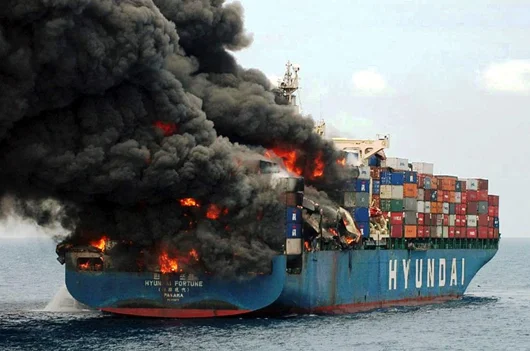
Lithium-Ion Battery Cargo Fire at Sea: NTSB Finds Improper Securing Behind Genius Star XI Christmas Day Incident. Improperly secured lithium-ion battery cargo combined with severe weather conditions triggered two major fires aboard the Panama-flagged bulk carrier Genius Star XI on Christmas Day 2023, according to a detailed investigation released by the U.S. National Transportation Safety Board (NTSB). The incident caused an estimated $3.8 million in damages and has raised renewed alarms over the maritime transport of large-scale battery energy storage systems (BESS).
Heavy Weather Turns Cargo Risk Into a Fire Emergency.
The 410-foot bulk carrier Genius Star XI was transiting the North Pacific Ocean when it encountered heavy seas on December 25, 2023. At the time, the vessel was carrying 192 lithium-ion battery energy storage system units, a cargo type known for its sensitivity to impact, heat, and mechanical damage.
According to investigators, lashing belt failures during the rough weather allowed 41 BESS units to shift violently inside the cargo hold. This cargo movement caused internal structural damage to multiple battery units, setting the stage for a catastrophic chain reaction.
Thermal Runaway: The Hidden Danger of Lithium-Ion Batteries.
The NTSB report confirmed that three battery units entered thermal runaway, a highly dangerous condition in which lithium-ion cells experience uncontrollable self-heating. Temperatures during thermal runaway can exceed 572°F (300°C), generating intense heat, flammable gases, and fire that is extremely difficult to extinguish at sea.
These thermal runaway events triggered two separate onboard fires, putting the vessel, crew, and marine environment at serious risk.
Critical Lashing Equipment Design Flaw Identified.
Beyond the weather, investigators identified a critical equipment incompatibility that undermined the entire cargo securing system. The issue centered on the mismatch between the D-rings and hook throat openings used in the lashing arrangement.
The NTSB stated:
“The diameter of the D-ring and the inner diameter of the hook (throat opening) were not compatible. The D-ring circumference was larger than the throat of the hook; essentially, the hook was not able to fully seat on the D-ring.”
Because of this mismatch, securing loads were concentrated at the bend of the hook, rather than being evenly distributed across the hook’s throat. Under heavy weather stresses, this design flaw caused the hooks to fracture and separate, leading directly to cargo movement and damage.

Growing Concerns Over Lithium-Ion Battery Transport by Sea.
The Genius Star XI incident highlights systemic risks associated with transporting large lithium-ion battery systems by sea, especially when cargo securing arrangements are not specifically engineered for the unique weight, rigidity, and hazard profile of BESS units.
With global demand for renewable energy storage, electric vehicles, and grid-scale batteries rising rapidly, shipments of lithium-ion batteries are increasing across major shipping routes. This case underscores the urgent need for:
Stricter cargo securing standards for battery systems
Compatibility verification of lashing hardware
Enhanced crew training on lithium-ion fire risks
Improved fire detection and suppression systems in cargo holds
Key Takeaways for the Maritime Industry
Heavy weather alone was not the sole cause; equipment incompatibility played a decisive role
Improperly secured lithium-ion cargo can escalate rapidly into uncontrollable fires
Thermal runaway remains one of the most dangerous fire scenarios at sea
Regulatory oversight and shipboard practices must evolve alongside new cargo types
 Conclusion
 Conclusion
The NTSB’s findings on the Genius Star XI serve as a critical warning to shipowners, operators, and regulators worldwide. As lithium-ion battery cargo becomes more common, traditional securing methods may no longer be sufficient. Without rigorous engineering checks and updated safety standards, similar incidents could pose escalating risks to lives, vessels, and the marine environment.
lithium-ion battery cargo fire, Genius Star XI fire, NTSB investigation ship fire, battery energy storage system shipping risk, thermal runaway at sea, cargo lashing failure ship, maritime lithium battery safety, bulk carrier fire incident.